

A memorable corporate retreat needs more than a packed calendar. A corporate retreat agenda example can unfold over three days: arrival and connection, strategy and shared experiences, then alignment and departure. Keep structured meetings to about four to five hours a day, leaving room for thoughtful conversation and time to explore surrounding destinations.
It’s easy to fill a schedule with sessions and activities, but the most useful retreats give each element a clear purpose. Work feels more focused when the team knows what it needs to accomplish, while shared experiences create a natural setting for connection beyond the conference room, often enhanced by customized group outings.
This guide offers a practical way to set retreat goals, choose a venue that supports your agenda, and adapt activities to your group’s size and needs. You’ll also learn how to balance focused work with movement and meaningful experiences, incorporating local excursions like those offered by Wine Tours of Sedona to give communication room to deepen amid inspiring scenery.
Key Takeaways
- Shape the retreat around a clear outcome, then divide the agenda into arrival and connection, strategy and experiences, and alignment and departure.
- Keep structured meetings to no more than four to five hours per day, leaving space for meaningful experiences and informal conversation.
- Match the venue and activity format to your group: smaller teams can focus on trust-building, while larger groups may benefit from rotating breakouts and multiple facilitators.
- Strengthen communication by pairing discussion with movement, offering opt-in activity choices, and making time to share insights afterward.
1. Adapting activities for different team sizes
Begin with the group’s purpose, then choose activities that let everyone contribute. A team of 10-15 people can use one facilitator for trust-building, guided discussion, or a shared outdoor challenge. For larger groups, rotating breakouts and multiple facilitators help keep participation active instead of leaving people at the edge. A leadership group of 4-12 people may prefer a focused walk-and-talk, where each person has room to speak. Match the activity’s pace and setting to the team, not simply its headcount.
What permits or rules apply to guided group hikes and outdoor activities near Sedona? Requirements depend on the land manager, trail, and activity. Before scheduling a guided hike, identify who manages the route and follow applicable permit, group-use, closure, and access rules. Plan for different mobility levels and comfort: offer a shorter outdoor break or quiet courtyard time alongside hiking, and make strenuous options opt-in. This supports connection without assuming everyone wants the same experience.
Heat and terrain also shape the agenda. From June through August, schedule hikes and excursions early in the morning or near sunset, when summer heat is less intense. Consider uneven surfaces, sun exposure, walking pace, and access to shade when choosing outdoor activities. A wellness break could be a gentle stretch, quiet reflection, or unhurried pause, rather than another demanding group exercise. Choose a shared meal that leaves time for conversation instead of rushing between activities.
What accessibility, heat, and safety risks should retreat planners consider in Sedona? Account for heat, exposed paths, uneven terrain, and differences in mobility or stamina; offer an accessible alternative and make participation voluntary. To balance work and experience, place meetings or workshops in the morning, then leave the afternoon for a hike, scenic outing, or restorative pause. Break work into 90-minute sessions and limit structured meetings to four to five hours per day. This rhythm gives groups time to think, move, share a meal, and return with fresh attention. A successful agenda makes each activity meaningful to the retreat’s goal.
2. Choosing a venue based on group size and agenda
Choose a venue by matching its rooms, setting, and services to the work. A leadership team of 4-12 people may benefit from a quiet meeting room, shared dining, and nearby space for reflection. For 10-15 people, consider whether everyone can gather comfortably for sessions and meals without splitting the group. Larger groups need enough breakout space to support parallel discussions and smooth transitions.
Build your venue shortlist around the agenda. A strategy-focused retreat needs practical meeting space for concentrated sessions; a connection-focused gathering may value outdoor access and unhurried shared dining more. Check how accommodations, meals, and wellness options fit the flow of each day. A private dining room can encourage focused conversation, while flexible catering can help keep meals aligned with the schedule.
What are typical costs for Sedona retreat venues, lodging, meals, and activities? Costs depend on season, venue, length of stay, dining choices, group size, and activity format. Compare these elements as one retreat budget, and consider what each quoted plan covers and how agenda changes could affect the total.
Season shapes the setting. March through May is described as one of the best periods, with comfortable temperatures for outdoor activities. September through November brings warm days and cooler evenings. December through February is quieter and may bring light snow, favoring indoor sessions and flexible outdoor plans.
What transportation options are available from Phoenix or Flagstaff to Sedona for retreat groups? Sedona is under two hours by car from Phoenix, making road travel a practical option for groups arriving there. From Flagstaff, choose ground transportation around the group’s arrival times, luggage, and planned stops, then coordinate local transfers with the venue schedule.
For groups of 4-12, choose a venue with a quiet meeting room, shared dining, and nearby space for reflection. Groups of 10-15 need room to meet and eat together, while larger groups should look for enough breakout space for parallel discussions.
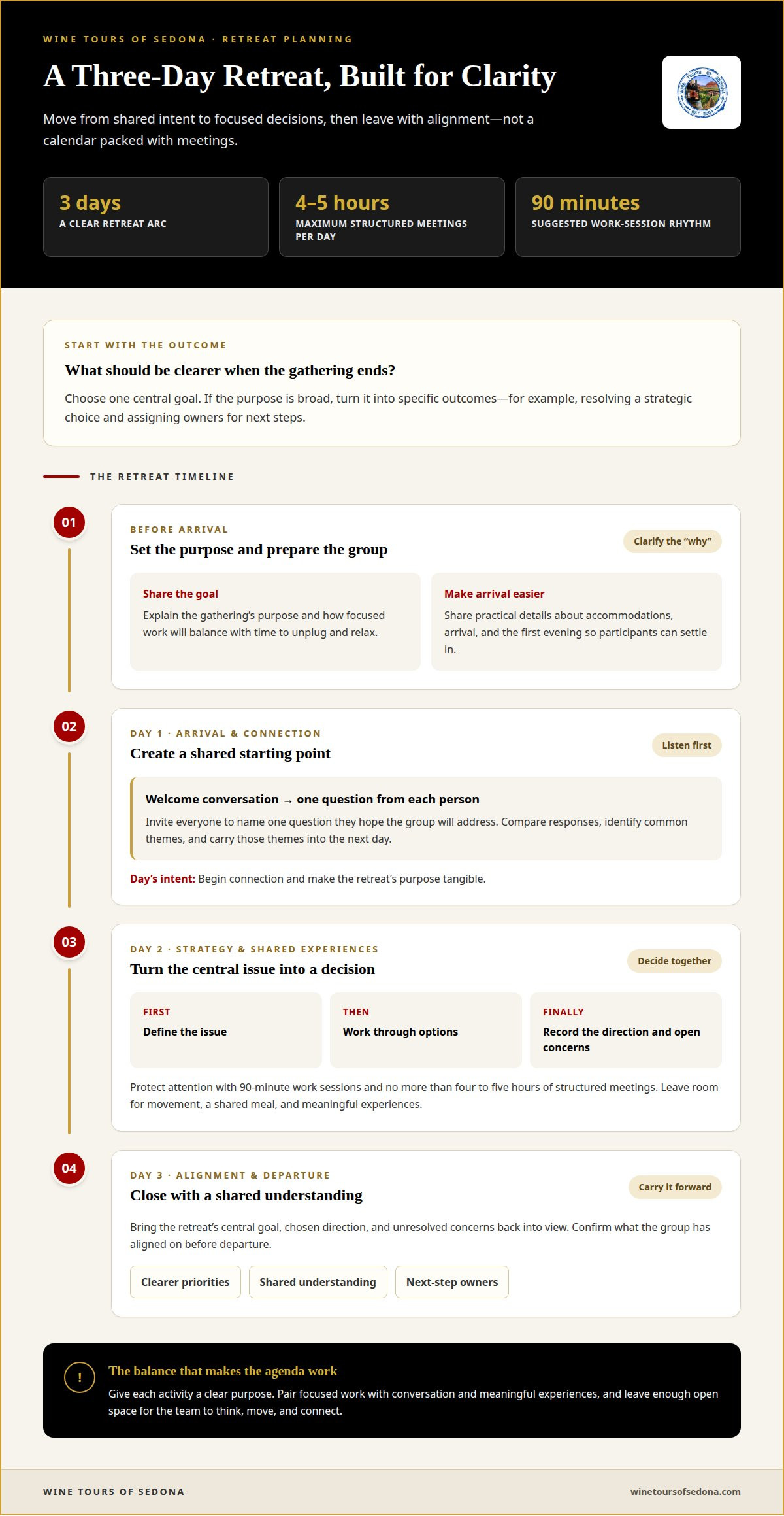
3. Clarifying retreat goals and intentions
Start with one central question: what should be clearer when the gathering ends? A leadership team might need agreement on priorities, while a department offsite may focus on communication across roles. Choose a goal to guide decisions throughout the retreat. If the purpose is broad, break it into specific outcomes, such as resolving a strategic choice and assigning owners for next steps.
Before arrival, share the gathering’s purpose and explain how the schedule balances focused work with time to unplug and relax. This context helps participants see why a conference session, outdoor experience, and shared meal all belong in the agenda. Include practical details about accommodations, arrival, and the first evening so everyone can settle in with fewer distractions.
Use the first day of a three-day retreat to establish connection and intent. After arrival and a welcome conversation, invite each person to name one question they hope the group will address. A leadership team can compare those questions, identify common themes, and carry them into the next day’s discussions.
Reserve the middle of the retreat for important decisions. A strategy session, for example, can begin by defining the issue, move through options, and end by recording the chosen direction and any unresolved concerns. Schedule a meaningful Sedona experience after concentrated work to give participants a change of pace before dinner or informal conversation.
On the final morning, turn decisions into commitments. Ask the group to state each action, its owner, and the next step, then capture the answers in one shared record. This creates a practical bridge from the destination experience back to daily work, instead of leaving ideas among the red-rock scenery.
Use the retreat goal to evaluate every agenda choice. If an activity doesn’t support the intended outcome, connection, or restoration, reconsider its place. A corporate gathering focused on team relationships might include a shared tasting experience, while a decision-focused offsite may need more quiet working time. This simple test keeps the schedule purposeful from arrival through departure.
4. Team building and communication
Choose a team-building format that gives every participant a comfortable way to contribute. A leadership team of 4-12 people can share a guided conversation, then take it outdoors for a walk-and-talk. For 10-15 people, one facilitator can help keep a trust-building activity focused and inclusive. Larger groups benefit from rotating breakouts, where smaller circles make it easier to hear different perspectives.
What are the best Sedona venues for corporate retreats and their meeting capacities? The best fit is a venue whose meeting room, breakout spaces, and shared areas suit your group’s size and agenda. Capacity depends on room layout, so match the venue’s stated setup to your sessions, dining plans, and outdoor transitions.
Use the red-rock landscape to support connection without making strenuous activity the only option. Hiking near Bell Rock and Courthouse Butte offers a shared outdoor experience, while a walk-and-talk pairs movement with focused conversation. You could also set aside part of a hike for quiet reflection, then gather to share observations. Make participation opt-in and offer a courtyard pause or quiet time as an alternative.
What team-building activities are available in Sedona, including hiking and wellness options? Teams can consider guided hikes, walk-and-talks, quiet reflection, and restorative breaks alongside shared meals. A wellness pause might mean stepping away from screens in a calm outdoor setting, with time afterward for conversation.
For a small group, seat everyone together and use a single prompt, such as “What helps us collaborate well?” A larger group can discuss that prompt in rotating circles, then bring key themes back to the center. This structure helps the team reconnect through specific examples rather than broad claims. To add a shared tasting experience to the retreat’s team-building plans, explore a Sedona team outing.
Wine Tours of Sedona: Sedona & Verde Valley Tour: Wine, Beer, Raw Chocolate, & Lunch
Wine Tours of Sedona offers the Sedona & Verde Valley Tour: Wine, Beer, Raw Chocolate, & Lunch as a shared experience for teams seeking a change of pace from conference sessions. It brings tastings and lunch together with the distinctive scenery of Sedona and the Verde Valley, creating space for informal conversation and connection. Consider it when the retreat agenda calls for a communal outing rather than another meeting, or when colleagues need time together beyond the conference room. The experience can complement strategic work by giving the group a relaxed setting to reconnect over regional flavors. For a wine-focused alternative, Wine Tours of Sedona also offers The Terroir of the Verde Valley Wine Trail and A Multi-Vineyard & Winery Tasting Experience. Contact Wine Tours of Sedona to discuss your retreat plans.
Shape the Next Chapter of Your Team’s Retreat
A corporate retreat agenda example for Sedona works best when its experiences build on the work your team has begun together. Choose the next step to suit the connection you want to nurture, whether that means lingering over regional flavors, discovering the Verde Valley, or sharing a change of scenery beyond the meeting room.
For teams drawn to wine country, Wine Tours of Sedona offers the Alcantara Estate Vineyards Tasting Experience, A Multi-Vineyard & Winery Tasting Experience, and The Terroir of the Verde Valley Wine Trail. Each offers a distinct way to bring colleagues together through the region’s character and viticultural landscape. Choose an experience that complements your gathering, then give the group space to enjoy it without turning every conversation into another agenda item.
When you’re ready to shape that shared outing, contact Wine Tours of Sedona to discuss your retreat plans. May your time in Sedona open the door to fresh perspective, genuine connection, and a renewed sense of possibility.
Frequently Asked Questions
What is a sample agenda for a corporate retreat in Sedona?
A corporate retreat agenda example for Sedona can follow a three-day structure: arrival and orientation, focused work and shared experiences, then commitments before departure. Open with check-in and a brief leadership welcome, reserve the middle day for a workshop and outdoor outing, and close with clear owners and next steps. This keeps the retreat’s purpose visible.
How many days should a Sedona corporate retreat last?
Three days can balance arrival, focused work, shared experiences, and departure. A corporate retreat agenda example in Sedona might use the opening day to welcome participants, the middle day for the main work, and the final morning to clarify commitments. A shorter retreat may suit a narrower objective. Choose the length based on travel, desired outcomes, and how much time the group needs together.
How can an agenda balance business sessions, outdoor activities, meals, and downtime?
Give each part of the day a clear role, with breathing room between transitions. Schedule the most demanding discussion when participants are fresh, use an outdoor experience to change pace, and leave meals open for informal conversation. Protect quiet time instead of filling every gap, and offer an alternative for participants who prefer rest to an activity.
Recent Comments